
Science is the highlight of the week for 2nd graders! But as much as we love the excitement of an amazing experiment, we also know that our literacy blocks are feeling the time squeeze. We need our students to do more than just watch things fizz and pop; we need them to read, write, and think like scientists. One way to solve this is to pair science experiments with reading passages!

How to match science experiments with reading passages
The secret to making science stick (without losing your precious reading time) is to build background knowledge by pairing hands-on labs with targeted nonfiction reading. When students read about a concept like seed dispersal or Earth changes before they see it in action, they aren’t just “doing an activity”—they are verifying what they’ve learned through text evidence.
Today, I’m sharing three of my favorite low-prep science experiments that pair perfectly with nonfiction reading passages to help your students build deep background knowledge while sharpening their close reading skills.
Experiment #1: Ice Cream in a Bag (Changing Matter Experiment)
This simple ice cream–in–a–bag experiment is a favorite way to help second graders see and feel how matter changes.
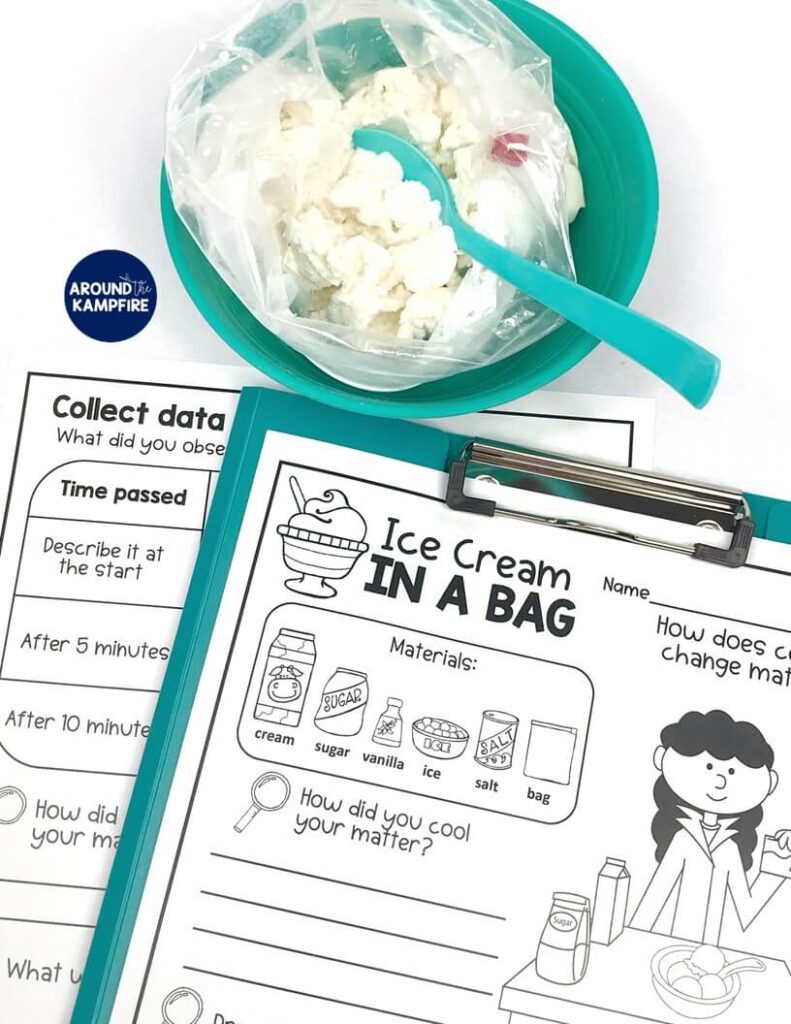
Students combine milk, sugar, and vanilla in a small sealed bag, then place it inside a larger bag filled with ice and salt. As they shake, the mixture transforms from a liquid into solid ice cream, giving students a concrete example of a physical change of matter. The salt lowers the freezing point of the ice, causing heat to transfer out of the milk mixture and speeding up the freezing process.
Cross-curricular science and reading activities
Pairing science experiments with reading passages about properties of matter helps students connect hands-on observations to scientific vocabulary, text evidence, and real-world applications.

Experiment #2: Water Erosion Simulation- A “Save the Lighthouse”
This hands-on “Save the Lighthouse” experiment helps students explore water erosion in a meaningful, problem-solving way. Students build small landforms using sand or soil, then simulate waves and rain to observe how moving water gradually wears away the land around a paper lighthouse.

As erosion occurs, students can clearly see how water changes Earth’s surface over time and why structures near coastlines are vulnerable.
When paired with a nonfiction reading passage about landforms and earth changes, this activity encourages students to connect cause-and-effect relationships, apply specific vocabulary, and use text evidence to explain what they observe. This turns the engaging experiment into a powerful science-and-literacy experience.

Experiment #3 Pollination STEM Activity
Instead of just reading about how plants reproduce, this pollination STEM activity gets students moving and thinking like real pollinators. By role-playing bees and transferring “pollen” from flower to flower, students actively model the pollination process and quickly see why it’s essential for plant growth and seed production.

The activity naturally reinforces science vocabulary and highlights the important relationship between plants and animals. When students pair this experience with a nonfiction text about pollinators, they’re able to make stronger connections, explain concepts in their own words, and support their thinking with details from the text—making the learning stick well beyond the activity itself.

Bridging the Gap Between Lab and Literacy
If you’re looking for an easy way to bring the reading piece into your science block, these leveled nonfiction passages are the perfect companion. Designed for 2nd and 3rd grade classrooms, the passages come in multiple Lexile levels so you can easily differentiate while teaching the same science content.
Each text includes standards-aligned comprehension questions that focus on close reading, text evidence, and informational text skills, making them ideal to use before or after a hands-on experiment. With printable and digital options included, you can seamlessly integrate reading, writing, and science—without adding extra prep to your already full day.

At the end of the day, science and literacy shouldn’t be competing for space in your schedule. When we integrate them, we give our students a reason to read and a way to apply what they’ve discovered. Watching a 2nd grader point to a diagram in a passage and say, “Look! That’s exactly what happened in our experiment!” is the ultimate “lightbulb” moment for any teacher.
If you’re ready to start combining science experiments with reading passages in your reading block but don’t have the time to hunt down leveled texts for every unit, I’ve done the heavy lifting for you!
My 2nd Grade Nonfiction Reading Passages Bundle includes 180 original, leveled passages covering everything from “Fast and Slow Earth Changes” to “Animal Adaptations.” Each one is designed to help your students master text-evidence tasks while exploring second-grade science topics.
FREE Printable Science Reading Passages

Be sure to save this post so you have it when you plan your science and reading lessons!



Leave a Comment