
In second grade, grammar instruction focuses on building a strong foundation in parts of speech, sentence structure, context, and mechanics to help students become strong writers and speakers. In this post, I’ve broken down what specific grammar skills to teach and in what logical order they should be introduced. Inside this post, I’ve also provided a free 2nd grade grammar scope and sequence PDF, along with a weekly pacing guide, to help you plan what skill to teach, the related standards at a glance, and a cumulative order in which to teach them.
This free grammar scope and sequence and pacing guide gives you a logical and systematic progression for building foundational skills before moving on to more complex ones. It gives you weekly pacing, as well as explains and gives examples for all 36 grammar and language standards in 2nd grade.
What is a Scope and Sequence?
In teaching, scope and sequences are basically a blueprint for your year. They help keep you on track and ensure your students are learning everything they need to in an order that makes sense. They map out what skills will be taught, when they’ll be introduced, and how they’ll build on one another over time.
Instead of feeling like you’re jumping from topic to topic (been there, done that), a strong scope and sequence creates intentional progression, allowing you to see the big picture while still planning week by week. It also helps with pacing, identifying gaps, and making sure nothing important gets skipped before the end of the year.
Why Sequence Matters
As teachers, we know that learning is layered and the early elementary years are crucial for building a strong foundation (It’s such a big reason as to why I LOVE teaching 2nd grade). Most grammar skills build on foundational knowledge, so when concepts are taught out of order, students can feel confused or frustrated.
A strong sequence ensures that students master prerequisite skills before moving on to more complex ones, which builds confidence and long-term retention. It’s also crucial for future years to ensure each grade level teacher knows what was already taught and what still needs to be taught from scratch.

Key Areas of Focus in 2nd Grade Grammar
There’s nothing better than watching the light bulb moments as your 2nd graders master new concepts and skills. And, 2nd-grade is jam-packed with new learning opportunities. Below, you’ll find the key areas of focus in 2nd-grade grammar!
1. Parts of Speech:
Teaching parts of speech should be hands-on, interactive, and connected to real reading and writing. By the time they reach 2nd grade, students are ready to move beyond simply identifying nouns and verbs and begin understanding how words work together in sentences.
At the beginning of the year, I like to introduce each part of speech in isolation first, then layer them together through sentence building, mentor texts, and interactive games. When students understand that nouns name, verbs show action or state of being, adjectives and adverbs add detail, and pronouns replace nouns, their writing becomes more specific and expressive. It’s really so fun to watch the progression!
2nd Grade Parts of Speech Scope and Sequence Overview
| Part of Speech | Focus Skills | Examples |
|---|---|---|
| Nouns | Proper nouns (capitalized names), common nouns, collective nouns, plural nouns, irregular plural nouns | Texas, dog, group, cats, children |
| Verbs | Present, past (regular & irregular), future tense, subject-verb agreement | walk/walked, sat, hid, will jump, She runs. |
| Adjectives / Adverbs | Describing nouns and verbs, comparative and superlative adjectives | big, bigger, biggest; quickly |
| Pronouns | Reflexive pronouns | myself, yourself, themselves |
Teaching resources to help teach parts of speech:
- Collective Nouns Apple Activities
- 8 Ideas for teaching Irregular Plural Nouns
- What are Concrete and Abstract Nouns (+ ideas to teach them)
- What are Possessive Nouns?
- Parts of Speech PowerPoints
- 9 Parts of Speech Activities
2. Punctuation and Capitalization:
Teaching punctuation and capitalization in 2nd grade is all about helping students see that conventions make their writing clear and easy to understand.
At this stage, students move beyond just periods and capital letters and begin applying rules with intention. I like to model these skills during shared writing, highlight them in mentor texts, and build in short daily editing practice so conventions become second nature.
When students understand why we use apostrophes, commas, quotation marks, or end punctuation, their writing becomes clearer, more organized, and more professional. Like all grammar skills, these conventions should be introduced explicitly, practiced in isolation, and then reinforced in authentic writing.
2nd Grade Capitalization & Punctuation Skill Overview
| Convention Focus | Specific Skills | Examples |
|---|---|---|
| End Punctuation | Periods, question marks, exclamation points | I like dogs. / Do you like dogs? / Watch out! |
| Apostrophes | Contractions and possessives | can’t, don’t, Sarah’s book, the dog’s leash |
| Capitalization | Holidays, product names, proper nouns, beginning of sentences | Thanksgiving, Nike, Texas, Monday |
| Commas | Greetings and closings in letters, lists, and phrases | Dear Mom, … Love, Emma. I need milk, eggs, and bread. |
| Quotation Marks | Dialogue in sentences | She said, “Come here.” |
Teaching resources to help teach capitalization and punctuation:
- Fun Sentence Type Lessons
- Activities to Teach Dialogue
- 7 Ways to Teach Contractions
- 6 No Prep Commas in a Series Activities
3. Sentence Structure:
I always find sentence structure to be a bit more complicated to teach than the first two. Your students have likely mastered the simple sentence, and it can sometimes be tricky to push them past this point. Teaching sentence structure in 2nd grade means intentionally guiding students from writing simple sentences to confidently constructing compound sentences.
Students should be able to identify a complete sentence with a subject and predicate, recognize and fix sentence fragments, and begin combining ideas using conjunctions like and and but.
Through sentence sorting, editing practice, and daily writing, students learn that strong writing is built on complete ideas and clear connections between them.
2nd Grade Sentence Structure Skills
| Skill Focus | Specific Skills | Examples |
|---|---|---|
| Complete Sentences | Identifying subjects and predicates; distinguishing sentences from fragments | The bird flew. / In the tall tree. (fragment) |
| Compound Sentences | Combining two complete sentences using conjunctions like and or but | I wanted to play, but it was raining. |
| Using Conjunctions | Connecting related ideas clearly | I like pizza, and I like pasta. |
Teaching resources to help teach Sentence Structure
4. Context:
Teaching context skills in 2nd grade helps students become more independent readers and thinkers. They are no longer reading just to decode, but are now moving towards reading to truly understand and learn.
Students should begin using context clues to determine the meaning of unfamiliar words instead of immediately asking for help (yay for increased independence!)
They also start recognizing how word parts, like prefixes and suffixes, change meaning, how compound words combine two known words to create a new one, and how tone and language shift depending on the situation.
Read-alouds are GOLD for teaching context. I always model “thinking aloud” during fun read-alouds to show students how to use surrounding sentences, illustrations, and word knowledge to figure out meaning. When explicitly taught and practiced consistently, these skills strengthen vocabulary development and overall reading comprehension.
2nd Grade Context & Word Meaning Skill Overview
| Skill Focus | Specific Skills | Examples |
|---|---|---|
| Context Clues | Using surrounding words, sentences, and illustrations to determine meaning | The desert was arid, with no rain for months. (arid = dry) |
| Prefixes & Suffixes | Determining meaning when word parts are added | happy → unhappy; play → playful |
| Compound Words | Using knowledge of individual words to predict meaning | sunflower, bathtub, snowman |
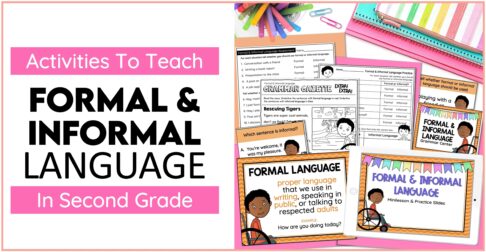
| Formal vs. Informal Language | Recognizing appropriate language for different situations | Informal: “What’s up?” / Formal: “Good afternoon.” |
| Literal vs. Nonliteral Language | Understanding exact meaning vs. figurative meaning | “It’s raining cats and dogs” (nonliteral) |
Teaching resources to help teach Context in 2nd grade:
- Books and Videos to Help Teach Context Clues
- Strategies to Teach Context Clue: 3 Questions To Ask Your Students
- 7 Fun Ways to Teach Suffixes
- 2nd Grade Prefix Activities (That Take 15 Minutes or Less)
- Formal and Informal Language Activities
- Activities to Teach Literal and Nonliteral Language
What is an effective 2nd-grade grammar curriculum?
An effective 2nd-grade grammar curriculum should be structured, standards-aligned, and easy for teachers to implement daily without hours of prep. A strong curriculum provides a yearlong progression of explicit lessons that build from basic skills like parts of speech and punctuation to more advanced conventions such as context clues, formal vs. informal language, and compound sentences.
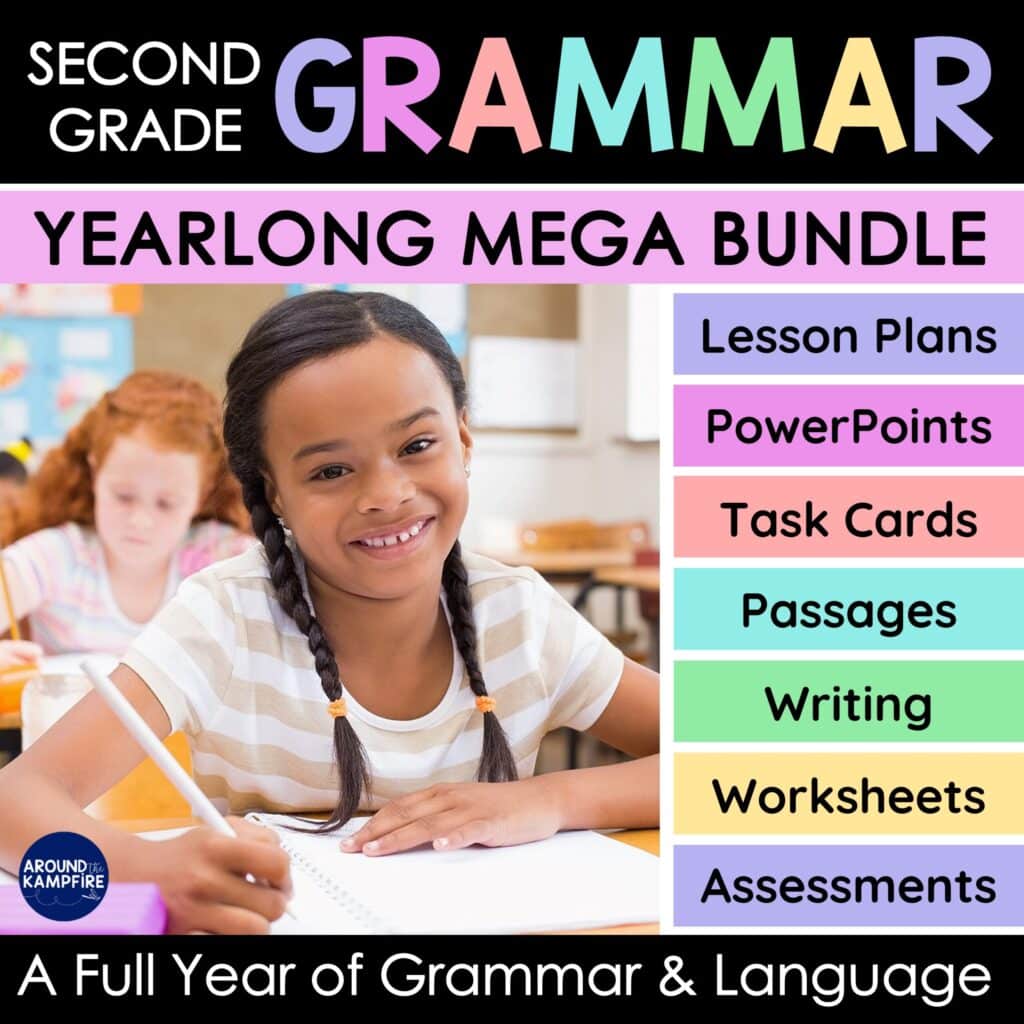
Inside my 2nd-grade Grammar bundle, you will find ready-to-use lesson plans, teaching slides, and a variety of practice formats, such as worksheets, task cards, reading passages, and writing activities, so students encounter each skill in multiple contexts.
Each week, it follows a predictable routine (e.g., mini-lesson, practice, center activity, application, assessment) to reinforce learning and build independence.
Free 2nd Grade Grammar Scope and Sequence PDF
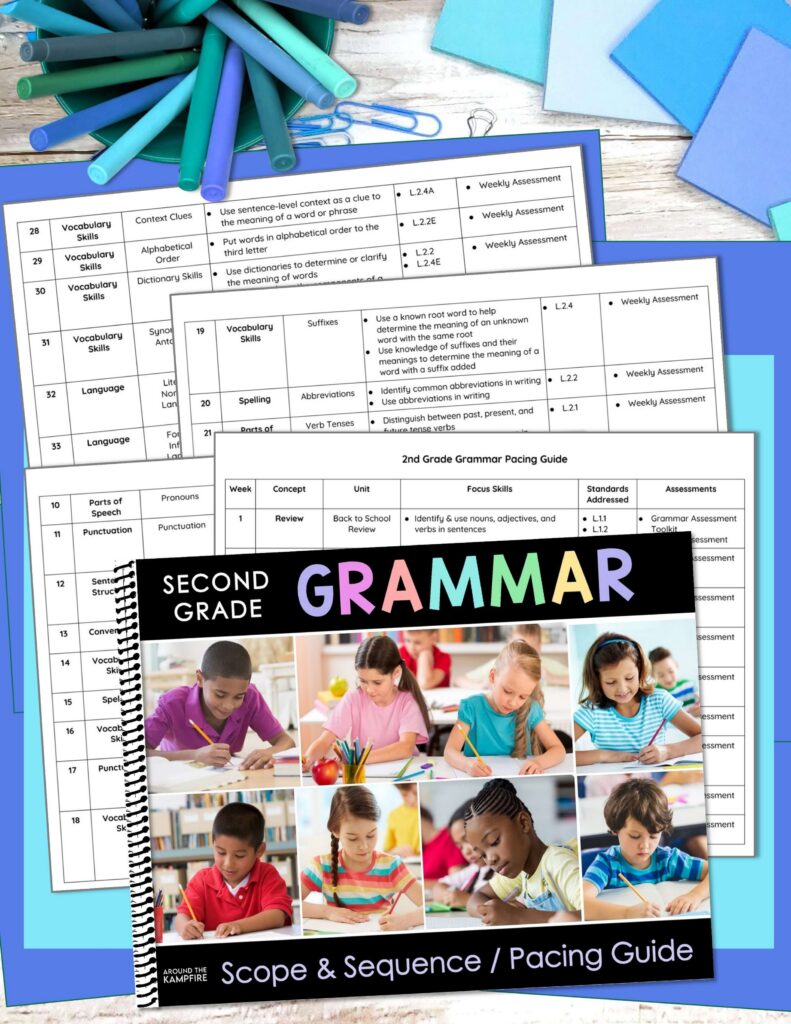
Pop your email address in below to get your FREE 2nd Grade Grammar Scope and Sequence PDF. Inside you’ll find 37 weeks of second grade grammar skills with each standard organized into one easy-to-follow chart. It even has links to no prep resources that make planning grammar a snap!
If you’re unsure what the grammar scope and sequence for 2nd grade is, then grab this free download and make your planning easier all year!






Leave a Comment