
Teaching main idea in 3rd grade is one of those skills that sounds simple… until you start grading student responses.
You end up with students who copy a sentence from the text. Then there’s the students who write a key detail as the main idea. Other students write 1-2 words and call it a main idea statement.
When you start seeing those responses, it’s time to go back to basics with main idea. I have a formula for teaching main idea in 3rd grade that has really served me and my students over the years. There are 3 key elements to my strategy: structure, repetition, and engagement.
One of the most effective ways to teach main idea in upper elementary is through informational science passages. Science texts are naturally structured to teach reading comprehension because they are centered around one focused concept. This makes it easier for students to identify how supporting details connect to the big picture.
Teaching main idea using science passages also builds engagement for students and allows you to create a predictable routine for practice and repetition. Practice makes perfect!
Why Teach Main Idea Using Science Passages?
When students read narrative texts, the “big idea” can feel abstract. A 3rd grade informational text about current events or a random standalone topic can feel too broad and lack the necessary engagement for success.
In contrast, science informational texts typically provide content that is focused, concrete, and interesting to students. The clarity in these texts helps students track how each detail connects to the big picture.
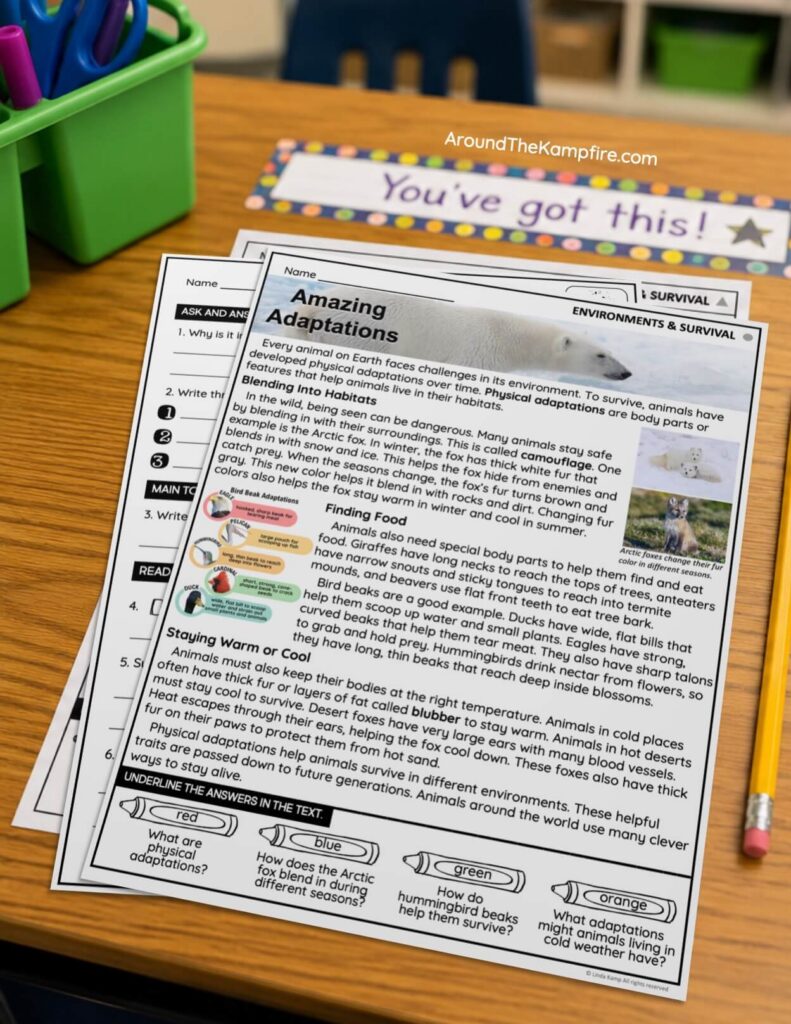
For example, in a 3rd grade science passage about adaptations, details might include:
Together, those key details support one central idea:
Each animal’s physical adaptations are perfectly suited to help them survive in their unique habitat.
Using structured 3rd grade science informational texts makes this pattern easier for students to recognize repeatedly throughout the year.
How I Teach Main Idea Using Science Passages in 3rd Grade
Now that you know why you should be teaching main idea using science passages, let’s talk about how you can help your students master this skill.
Strategy 1: Teach the Difference Between Topic and Main Idea
Before students can identify the main idea, they must understand the difference between topic and main idea.
If the title is The Water Cycle, the topic is the water cycle.
But the main idea might be:
The water cycle is the continuous movement of water through evaporation, condensation, and precipitation.
Help your students understand that the topic can be a word or phrase that describes the entire subject. It can usually be identified by reading the title or glancing at images and other text features in a passage.
On the other hand, the main idea requires more thought and consideration. Explain you have to read the text more than once to write a complete main idea statement.
This distinction is foundational in 3rd grade reading comprehension.
Strategy 2: Follow Through with a Strong Reading Routine
When you have a consistent reading routine for informational texts, you’re setting your students up for success. With so much focus on main idea in 3rd grade, you’ll want to focus on developing a strong routine that centers around determining the main idea of informational texts.
Students need to know that in order to truly understand a text and a concept, they will absolutely need to read it through more than once.
In my classroom we follow a reading routine that involves at least 3 readings of a text. I love using science passages to reinforce these close reading skills because they are short, clear, and focused.
Our reading routine for informational texts looks like this:
1. Prereading
2. First read
3. Second read
4. Write a main idea statement
5. Third read
In the beginning of the year and when I am first teaching main idea in 3rd grade, I model this entire process with our science informational texts.
For example, a think aloud to model the pre-reading process might sound like:
This article is called Amazing Adaptations. I see that there are 3 headings: Blending Into Habitats, Finding Food, and Staying Warm or Cool. It seems like I’m going to learn about adaptations that help animals with those three things. There’s two photographs of foxes in their habitats. I also see an informational graphic about bird beak adaptations. I think I’ll be learning about how different adaptations help different animals do things they need to do.
After students begin to get the hang of it, I have students do the 2nd and 3rd readings as independent work or group work.
This reading routine helps students build an understanding of the main idea of a text because each part of the routine requires students to identify features that contribute to the text’s big message.
Strategy 3: Look for Repeated Ideas in the Science Text & Text Features
High-quality informational science passages will include a variety of nonfiction text features, which are an excellent tool for understanding and teaching main idea in 3rd grade.
After the first or second reading of a science text, ask students:
Direct students’ attention to the text features while you search for repeated ideas.
Have your students look for more repeated ideas or patterns in text features like:
Strategy 4: Use Paragraph Main Ideas to Reach the Whole-Text Idea
Finding the main idea of the whole text can be overwhelming for students.
Break it down into digestible chunks by identifying the “gist” of each paragraph.
After reading one paragraph, ask:
Then ask:
For example, in our phenomena-based article about horseshoe crabs, I would guide students toward finding the gist of each paragraph kind of like this (I wrote in complete sentences for this example, but wouldn’t require my students to do that typically for the gist):
Paragraph 1:
Horseshoe crabs are called “living fossils” because their adaptations are so strong they have not had to change much in millions of years to survive.
Paragraph 2:
Horseshoe crabs use their body parts to stay safe from predators.
Paragraph 3:
Horseshoe crabs have special sensors on their bodies to detect light, movement, and environmental changes.
Paragraph 4:
Horseshoe crabs have a flexible diet and can even go without food for up to a year.
Paragraph 5:
Horseshoe crabs have special cells in their blood that fight bacteria and help them survive injuries and prevent infections.
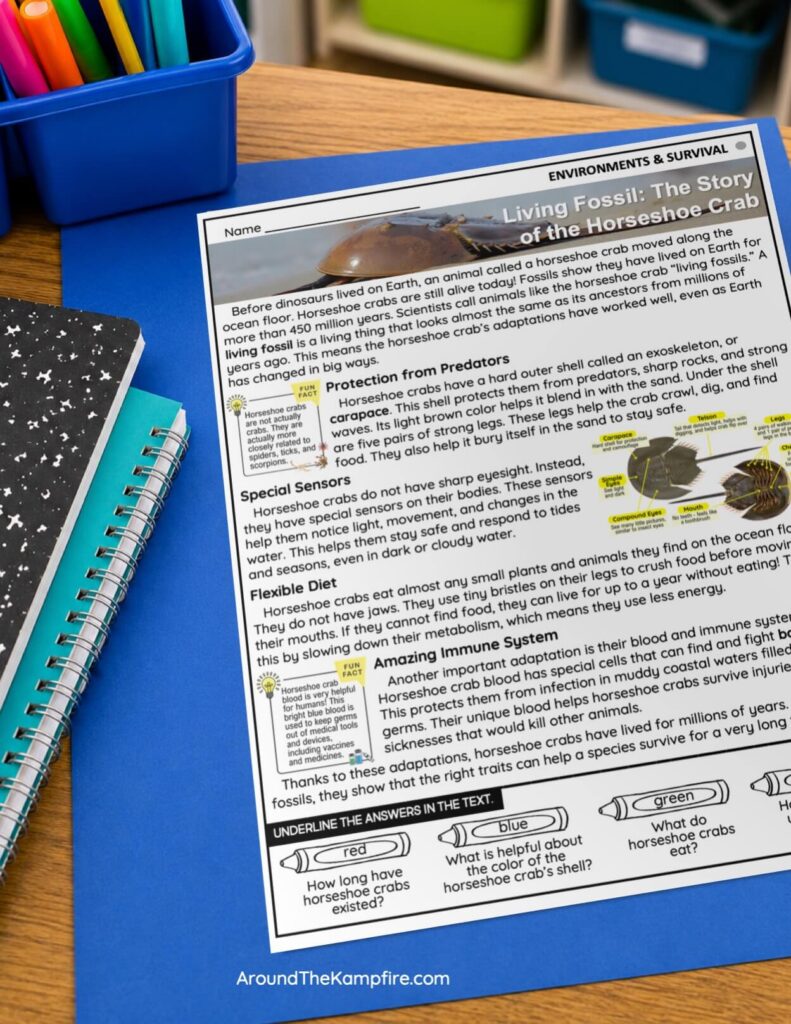
When students combine those ideas, they start to see the main message of the whole text coming through: Horseshoe crabs have been able to survive as a species for millions of years because of their unique powerful adaptations.
Passages that include clear headings make this even easier. Headings often signal the focus of each section, giving students helpful clues about the gist.
Strategy 5: Use a Repeatable Structure for Writing a Main Idea Statement
One of my biggest pet peeves when it comes to teaching main idea in 3rd grade is when my students write a main idea statement that starts with “The main idea is” and then gives a word or a few words that generally describe the article. Something like “The main idea is how animals survive” is not going to cut it for upper elementary students.
Main idea statements should be complete sentences that tell the whole idea of a text, focusing on what the author wants the reader to learn or understand. They should not start with the phrase “The main idea is”. This sentence format does not support understanding of the message of the entire text, and it is not the format 3rd graders will see on standardized assessments, either.
When my students are struggling to write a complete main idea sentence (which inevitably happens every year!), I prompt them to answer some version of the 5 Ws and H (who, what, when, where, why, how).
When we are ready to determine the main idea of a text, I write these questions on the board:
Who or What?
Do What?
When?
Where?
Why?
How?
After reading a text, I ask students to give brief, simple answers to these questions. For example, for our 3rd grade informational text about how animals survive through group-living, our answers might look like:
Who or What? Animals
Do What? Live in groups
When? Often
Where? In their environments
Why? To stay safe and survive
How? By communicating and working together
After answering these questions, I erase the questions so that only the answers to those questions are visible:
Animals
Live in groups
Often
In their environments
To stay safe and survive
By communicating and working together
Then, we discuss how we can combine these phrases into a complete sentence that makes sense and sounds right. Sometimes we also discuss if all of the questions/answers are relevant to the science passage we’re working on.
For this example, our main idea statement might be something like:
Animals often live in groups, work together, and communicate to stay safe and survive in their environments.
I encourage students to practice this strategy in groups and independently. Teaching main idea in 3rd grade is such a huge focus, so I reinforce this process in all informational texts we read, including ALL of our 3rd grade science reading passages.
Tip: Give students a post-it note or an index card to work through this strategy for each article you read. With enough practice, they will start to do this process on their own in their heads, but I find that in the beginning having a designated place to write the questions and answers is very helpful!
A Weekly Routine for Teaching Main Idea With Science Texts
Consistency builds mastery. Even if you only have 15-20 minutes a day for incorporating these science passages, it’s completely achievable to complete all of these steps and build main idea mastery.
Here’s a repeatable structure that works when you’re on a time crunch:
Day 1: Prereading, first read of the passage, identify overall topic
Day 2: Second read to find the gist of each paragraph
Day 3: Draft the main idea sentence together
Day 4: Analyze supporting details
Day 5: Answer text-dependent questions
Rotating through engaging science topics like ecosystems, weather, fossils, and life cycles allows students to practice main idea across multiple content areas.
Using a cohesive set of 3rd grade science passages ensures consistent formatting and structure, which supports student independence.
Why This Strategy Strengthens Reading and Science
Teaching main idea through science passages allows students to:
Instead of isolating reading skills, you’re embedding them in meaningful content.
Ready-to-Use 3rd Grade Science Passages for Main Idea Practice
If you are looking for:
The passages and readers in this 3rd Grade Science Informational Passage Bundles are designed to support skills like main idea while reinforcing science standards.
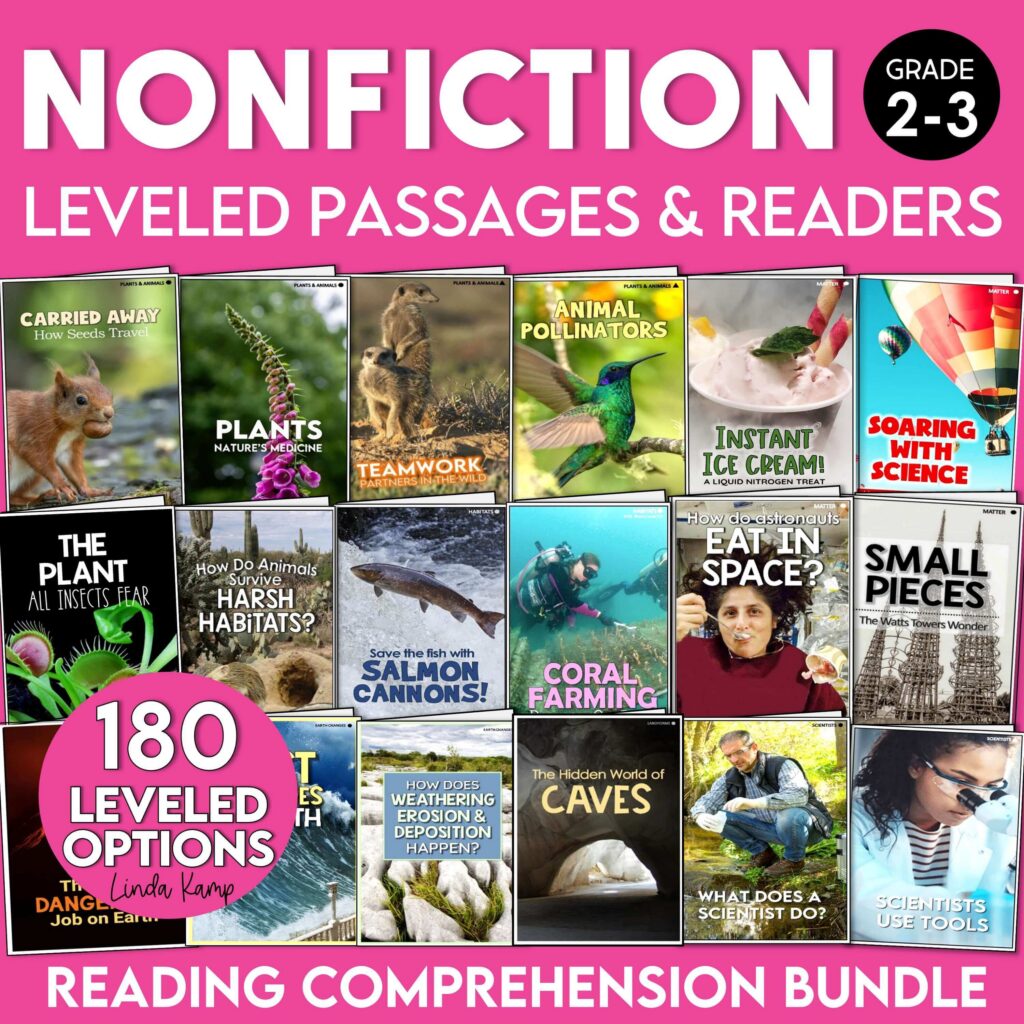
These resources provide ready-to-use nonfiction passages so you can focus on instruction instead of creating materials from scratch!
Save this post so you can incorporate these strategies while you plan your integrated science and literacy lessons!



Leave a Comment