
Building nonfiction reading comprehension in 2nd grade is about more than just answering questions—it’s about teaching our students how to understand, think about, and learn from what they read. As students make the shift from learning to read to reading to learn, nonfiction texts play a critical role. In this post, you’ll discover strategies for helping your 2nd graders and 3rd graders build nonfiction comprehension skills using text features, context clues, and high-interest science passages they’ll love.

Using nonfiction reading passages and science readers in your classroom helps students build the skills they need to read for knowledge. These texts give students a chance to explore real-world topics while practicing how to:
- Identify the main idea and details
- Answer text-based questions
- Use text features to gain information
- Determine word meanings using context clues
What Is Nonfiction Reading Comprehension?
Nonfiction reading comprehension is the ability to interpret factual information read in informational texts. It requires students to recognize and understand several important elements as they read. Below is a list of the organizational patterns we begin teaching in second grade.
Nonfiction Text Structure
Nonfiction texts often use cause/effect, compare/contrast, and problem/solution. Teaching students to recognize these structures helps them understand actions and consequences, similarities and differences, and approach problems and challenges in a step-by-step manner. Learning to identify and understand these helps students develop critical thinking and problem-solving skills.
Additional aspects of nonfiction comprehension to teach are:
- Identifying the main idea
- Recognizing key details
- Previewing titles, headings, and illustrations before reading
- Summarizing
- Using context clues to determine meanings of unknown words
- Using text features to learn more about the topic
What Are Nonfiction Text Features?
I teach students that nonfiction text features are special parts of informational text that help readers understand more about the topic. They’re like little tools that give clues and details beyond the main paragraphs. Teaching students to look closely at print features helps them learn and understand more than what the words on the page are telling them. It also helps them locate information quickly.
| Text Feature | Purpose |
| Headings | Show what a section or paragraph is about |
| Photographs | Give real-life visuals to match the topic |
| Captions | Explain what’s shown in the photo or picture |
| Bolded Words | Highlight important words and vocabulary |
| Diagrams | Show how something works |
| Labels | Identify parts of an image or diagram |
| Graphs & Tables | Present facts in a way that’s easy to compare and analyze |
| Infographics | Combine images and facts to explain ideas clearly and simply |
Photographs and illustrations show students what something looks like or how something works. Diagrams illustrate the parts of an object or the steps in a process.

Charts and graphs present information in a visually organized manner making it easier to compare and analyze information.

Infographics simplify complex ideas and data. Some infographics are like colorful posters. They use pictures, charts, and diagrams to help younger students grasp information or see what something looks like.

Using Context Clues
When students encounter an unknown word in a nonfiction text, they can’t always rely on pictures or background knowledge. They can use context clues to determine its meaning.

Context clues are hints around a word that help readers understand what the unknown word means.

To use context clues, have your students do the following:
- Reread the sentence before and after
- Look for explanations or examples
- Think about what the passage is about overall
- Use the picture, heading, or diagram to help
Learn more about the 5 main types of context clues with examples, plus the three questions to ask your students when teaching and practicing using context clues. Find tools for how to use this vocabulary strategy to teach context clues that will help your students learn to determine the meanings of previously unknown words.
Resources to Teach Nonfiction Reading Comprehension
To save you time and make differentiation easy, I’ve written a series of high-interest, leveled reading comprehension passages with question sets and informational science readers for kids about engaging topics that focus on helping 2nd graders comprehend informational texts, use nonfiction text features, and understand vocabulary through context clues.

This resource includes:
- 3 leveled versions of each text (350–450L, 450–550L, and 550–650L)
- Ready-to-use, standards-based comprehension questions focusing on:
- Text evidence
- Vocabulary and context clues
- Main idea and details
- Nonfiction text features
- Printable and digital formats for flexible use
Easy ways to use informational passages
- Whole-group reading with shared highlighting of text features
- Small-group guided reading with leveled versions
- Partner reading and feature-finding
- Independent reading and comprehension centers

These readers cover exciting topics that 2nd graders want to read about:
- What real scientists do
- Animal habitats and behaviors
- Plant and animal needs and life cycles
- Science tools
- Landforms
- Fast and slow Earth changes
- And many more topics!
When students are curious, they read with more purpose—and comprehension skills grow naturally.
Want to make nonfiction reading comprehension in 2nd grade easier to teach and more fun to learn?
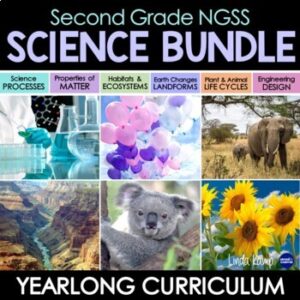
Try this series of leveled science passages and readers or grab the money-saving bundle Nonfiction Reading Comprehension Passages & Science Readers . These printable science readers and comprehension passages are the best nonfiction comprehension passages for 2nd graders that use science content to boost informational reading skills.
Shop This Post

Nonfiction Reading Passages Gr. 2 BUNDLE
Original price was: $29.75.$23.80Current price is: $23.80.
Shop This Post

Shop This Post

Shop This Post

Shop This Post

Shop This Post

Try these helpful strategies for boosting your students’ nonfiction reading comprehension. Check out these high-interest nonfiction science readers and informational passages that make it easy to differentiate and practice for every level!



Leave a Comment